


Achieving perfect transparency in polyethylene films while maintaining an extremely low coefficient of friction (COF) remains one of the most complex challenges in extrusion processes today. Engineers have consistently struggled with the inherent optical compromises of common plastic additives. Traditional inorganic opening agents often result in unacceptable haze, scattering light and compromising the film’s visual performance—a fatal flaw for high-end display packaging. The scientifically advanced PE Slip Anti-blocking Masterbatch bridges this gap perfectly. By employing refractive index-matched components and high-purity carrier resins, it delivers exceptional surface smoothness and processing efficiency without sacrificing crystal-clear visibility.
Photophysics in Polymer Extrusion
How Additive Particles Create Haze
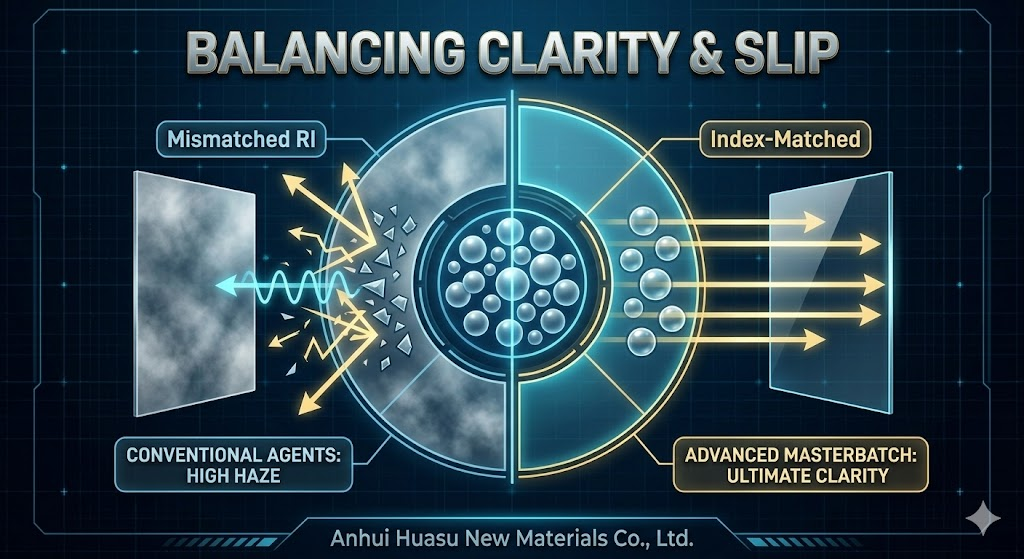
In flexible packaging, optical clarity is defined by low haze and high light transmittance. The fundamental mechanism of opening action utilizes solid particulate matter to create microscopic roughness on the surface to prevent film adhesion. However, when light passes through the polyethylene matrix and strikes these solid particles, the light waves are scattered. This internal and surface scattering manifests as haze, dulling the film’s glossy appearance. Unoptimized additive formulations force manufacturers to make difficult compromises: either choose high transparency but with severe adhesion, or choose easy unwinding but with hazy and poor optical performance. The dedicated PE Slip Anti-blocking Masterbatch was developed to completely eliminate this dilemma.
The Key Role of Refractive Index (RI) Matching
The severity of light scattering mathematically depends on the difference in refractive index (RI) between the base polymer and the added additive particles. Natural minerals such as talc or standard calcium carbonate have a significantly different RI value from polyethylene (whose RI is typically around 1.51). When using these inexpensive fillers, light distortion is severe. The advanced formulation of the PE Slip Anti-blocking Masterbatch uses advanced synthetic silica. This high-purity silica is carefully selected because its refractive index perfectly matches the PE matrix, allowing light to pass through the blend film with near-zero distortion.
Developing the Ultimate PE Slip Anti-blocking Masterbatch
Synergistic Migration Rheology
Manufacturing high-performance PE Slip Anti-blocking Masterbatch requires mastery of polymer rheology and the synergistic effects of additives. Formulation must strike a balance between the rapid migration of slip agents (such as erucamide or oleamide) and the static physical spacing provided by open particles. If, during the melting phase, the slip agent excessively coats the highly porous silica particles, it will effectively neutralize the function of both additives. Advanced granulation technology ensures that the slip molecules and the rigid silica structure function independently yet coexist harmoniously as they reach the film surface during the cooling phase.
Controlled Particle Size Distribution (PSD)
Visual clarity depends heavily on the precise geometry and size of the open agent. Superior PE Slip Anti-blocking Masterbatch incorporates a tightly controlled particle size distribution (PSD). Oversized particles can pierce the film surface and cause catastrophic visual defects, commonly referred to in the industry as “fisheyes” or specks. Conversely, excessively small particles cannot create enough physical space to separate the film layers, leading to vacuum adhesion. Optimal PSD engineering ensures maximum spacing efficiency with the absolute lowest possible additive dosage.
Carrier Resin Compatibility and Melt Dispersion
The carrier resin in the masterbatch plays a surprisingly crucial role in optical results. If the melt flow index (MFI) of the masterbatch carrier does not match that of the pure polymer, flow marks and optical distortion known as melt drooling will occur. High-quality PE Slip Anti-blocking Masterbatch uses a highly compatible, low-gel pure polyethylene carrier to ensure uniform melt dispersion within the extruder barrel and prevent optical degradation.
Solving Optical Defects in Production
Eliminating Die Drool and Melt Droop
In addition to surface properties, advanced PE Slip Anti-blocking Masterbatch also serves as a critical processing aid. During high-speed blown film extrusion, polymer shear stress at the die lip can cause die drooling. This buildup eventually detaches, dragging along the film bubble surface and creating visible die lines that compromise clarity. The slip-resistant component continuously lubricates the die lip, preventing buildup and ensuring a glass-like finish on the extruded film roll.
Prevention of Surface Scratches During Winding
Without effective anti-blocking measures, tightly wound film rolls are subjected to immense internal pressure. When the film layers shift slightly during transport or high-speed unwinding, the smooth surfaces rub against each other, creating micro-scratches. These micro-abrasions significantly increase surface haze. The rigid silica in PE Slip Anti-blocking Masterbatch acts as a physical buffer, protecting the film’s original, glossy surface from mechanical damage.
High-Transparency Industrial Applications
High-End Flexible Packaging and Composite Films
For flexible packaging used in cosmetics, multi-layer food coatings, and high-end retail bags, optical perfection is non-negotiable. Consumers equate high gloss and low haze with premium product quality. The integrated advanced PE Slip Anti-blocking Masterbatch ensures smooth operation of packaging on demanding, high-speed transfer and laminating machinery while maintaining crystal-clear product visibility.
High-Transparency Agricultural Films and Heat-Shrink Films
Even in highly functional applications such as agricultural greenhouse films or POF (polyolefin) heat-shrink films, light transmittance is crucial. For greenhouses, maximizing photosynthetically active radiation (PAR) transmittance is essential for optimizing crop yields. By using the highly efficient PE Slip Anti-blocking Masterbatch, manufacturers can guarantee that these large protective films can be easily deployed on-site, completely avoiding adhesion problems, without sacrificing the critical UV and visible light transmittance required for agricultural success.