


Tabla de contenido
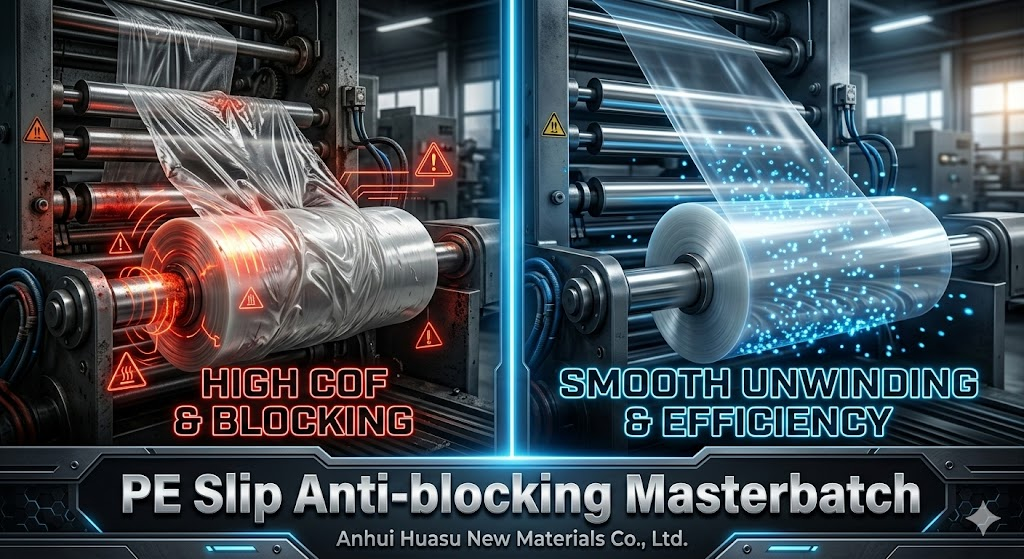
In the high-speed packaging industry, mechanical friction is the biggest efficiency bottleneck. Polyethylene films often face problems of surface stickiness and excessively high coefficient of friction (COF), which can lead to severe machine jamming and workflow disruptions.
When packaging lines are forced to slow down, a company’s operating profits plummet. Ordinary lubricants often fail under extremely high thermal stress or exhibit highly unstable migration rates.
Introducing a high-quality PE Slip Masterbatch antibloqueo is the most thorough engineering solution. Specifically designed to address surface sticking issues, it ensures smooth unwinding and optimal throughput throughout the automated packaging system.
Friction Pain Points on Packaging Lines
High Coefficient of Friction and Film Dragging
Untreated polyethylene naturally has a high COF during extrusion and subsequent processing. This generates significant drag forces on metal mechanical parts, rollers, and sealing strips. As tension increases, the film is prone to stretching or tearing, leading to severe downtime. The reliable PE Slip Masterbatch antibloqueo directly alleviates this mechanical drag by creating a micro-lubricating layer on the polymer surface.
Blocking Between Membranes
When extruded films are rolled into rolls, extreme pressure and residual heat force the smooth polymer layers together—a phenomenon known as blocking. This adhesion makes high-speed unwinding nearly impossible without tearing the surface. Using a high-quality PE Slip Masterbatch antibloqueo can prevent this by introducing rigid microscopic protrusions that physically separate adjacent film layers.
Mechanism of Action of PE Slip Anti-blocking Masterbatch
Accelerated Amide Migration
The slippery components in PE Slip Masterbatch antibloqueo rely on primary amides (such as erucamide or oleamide). Once the polymer leaves the die and cools, these amide molecules become incompatible with the PE matrix. They rapidly migrate to the surface, crystallizing to form a robust and invisible lubricating shield, significantly reducing dynamic friction.
Microscopic Roughness Surface Modification
Simultaneously, the opening agent (typically synthetic silica or natural minerals) plays a physical and mechanical role. The PE Slip Masterbatch antibloqueo uniformly disperses these particles within the melt. Upon cooling, they create localized micro-roughness on the film surface, minimizing the contact area between film layers and allowing air permeation, thus completely eliminating the vacuum effect that leads to adhesion.
Maximizing Production Efficiency
Improved Demolding and Sealing Efficiency
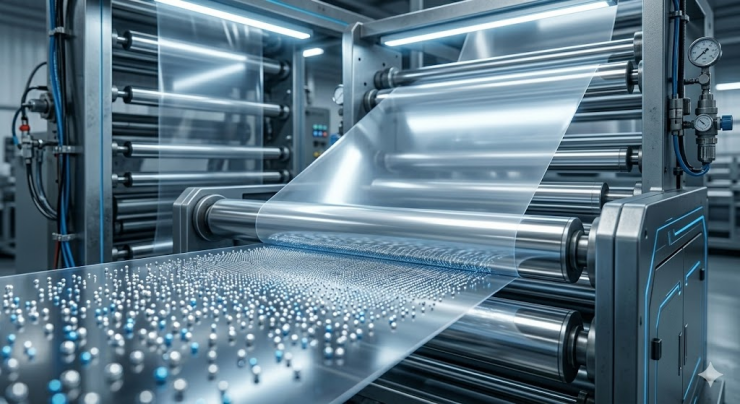
In Form-Fill-Seal (FFS) applications, rapid demolding is crucial. The addition of the PE Slip Masterbatch antibloqueo ensures that thermal adhesion forces do not cause the film to stick to the sealing claws. This reduces cycle time and lowers defect rates in the final packaging stage.
Stable High-Speed Unwinding
Ultimately, the purpose of deploying a dedicated PE Slip Masterbatch antibloqueo is to maintain uninterrupted automated production. By balancing the precise ratio of slip agent and opening agent, manufacturers can achieve predictable high-speed unwinding. This significantly reduces waste, lowers energy consumption, and extends the lifespan of packaging machinery.